"It was just crushing to see so many dead turtles in the road." That's how Kristen Mazzarella, executive director of Anna Maria Island Turtle Watch and Shorebird Monitoring, described the scene her team found on a local roadway on August 14, 2026, after 55 hatchlings crawled toward artificial light instead of the Gulf. Her volunteers made it in time to save some. They couldn't save all of them.
If you're renovating a beachfront home on Anna Maria Island right now, or planning to once you close, that sentence should land differently than it does for a visitor reading a news story. It's not a wildlife item. It's a compliance risk sitting inside your renovation budget that almost nobody itemizes, and it's one your contractor's permit will never flag, because it isn't a building code problem. It's a lighting problem, and it doesn't show up until months after your certificate of occupancy is signed.
The Inspection That Never Happens At Closing
Every renovation on the island goes through the inspections you'd expect: electrical, structural, flood elevation, final walkthrough. None of those inspections check whether your new rooftop deck lighting, your pool spotlights, or the sconces on your exterior stairwell are visible from the beach at night. That check happens later, informally, and usually only after something has already gone wrong.
Anna Maria, Holmes Beach, and Bradenton Beach all have lighting ordinances tied to sea turtle protection, a fact confirmed by multiple volunteers who work the beach every morning during nesting season. But enforcement isn't proactive in the way flood zone compliance or setback requirements are. It's reactive. When a disorientation event happens, someone from Turtle Watch responds, looks at which properties could plausibly be the source, and contacts the owner directly to ask for a fix. There's no annual lighting audit tied to your renovation permit. There's no line on your final inspection checklist. Your home can be fully permitted, fully occupied, and fully out of compliance, and the first anyone hears about it is a phone call after hatchlings turn up in a storm drain instead of the surf.
Holmes Beach has actually built this into a staff role. Code Compliance Officer Jayson Clayton serves as the city's liaison with Turtle Watch and is tasked with monitoring beachfront lighting during nesting season and working with owners to bring violations into compliance. That's a meaningful detail if you're buying in Holmes Beach specifically. It means there's a named person whose job includes checking your lights, not just your setbacks.
What The Rule Actually Asks For
The standard, set by Florida's Fish and Wildlife Conservation Commission, comes down to three requirements that apply to any fixture visible from the beach:
- Mounted as low as possible for the job it needs to do
- Producing the lowest wattage necessary, in long-wavelength light (560 nanometers or greater, which reads as amber, orange, or red)
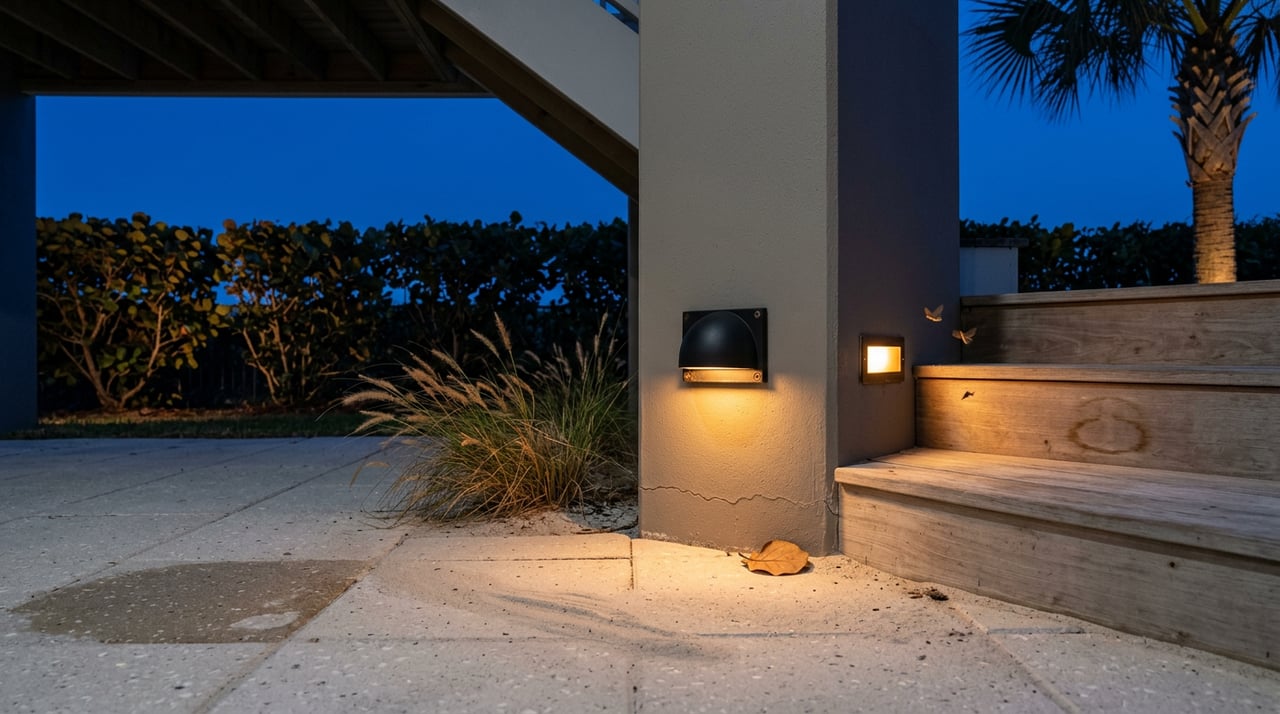
- Fully shielded and directed downward, so the bulb itself is never visible from the sand
That's it. It isn't a request to go dark. It's a request to redirect and recolor. A pool light, a step light, a porch fixture, an uplit palm at the base of your new lanai, all of these can stay if they meet the three rules. What can't stay, regardless of how tasteful it looks in a listing photo, is anything white, bright, unshielded, or elevated enough to throw glow onto open sand.
The Cost Isn't the Obstacle. The Calendar Is.
Here's the part that surprises most owners: this is rarely an expensive fix. Suzi Fox, the longtime former director of Turtle Watch, has talked about the early years of lighting enforcement on the island, when the assumption among property owners was that compliance would cost thousands of dollars. It didn't. Once turtle-friendly LED bulbs and shielded fixtures became widely available, most retrofits ran a couple hundred dollars. Turtle Watch will even advise you on your specific fixtures at no charge, and in some cases can provide amber bulbs directly.
So if cost isn't the barrier, what is? Timing. Nesting season runs from May 1 through October 31, which means it overlaps almost perfectly with the busiest renovation window on the island, the stretch between one winter rental season and the next when owners tear out kitchens, redo pools, and rebuild rooftop decks. A project that finishes in June and flips on brand-new white sconces for July guest photos is finishing during the exact five months when that lighting choice carries the highest risk of triggering a complaint. The renovation and the compliance window are not sequential. They're happening at the same time, and most owners never connect the two until something forces the connection.
This year has made the stakes harder to ignore. As of mid-August, Turtle Watch had recorded more than 3,000 disoriented hatchlings and roughly 140 confirmed deaths for the 2026 season, with more than 250 nests still left to hatch. Hurricane damage from 2024's storms stripped away dune vegetation that used to block light from reaching the sand, which means fixtures that were arguably fine five years ago may not be fine now. A home that passed a casual glance in 2021 can be a genuine problem in 2026, with no renovation, no new construction, and no change to the property at all.
What This Means If You're Mid-Renovation Now
If you're actively renovating a beachfront home on Anna Maria Island, or closing on one that needs work before it goes into rental rotation, a few decisions are worth making before the contractor finishes the punch list rather than after:
- Ask your electrician or lighting designer to spec amber or red LED fixtures at 560nm or greater for anything visible from the beach side of the property, not just anything technically "outdoor."
- Request shielded, downward-directed fixtures for decks, stairs, and pool areas rather than decorative uplighting, string lights, or anything that throws light sideways or upward.
- If you're unsure whether a finished install is compliant, call Turtle Watch's 24-hour hotline at 941-301-8434 before your first guest season, not after a complaint.
- If you're buying a home that already has exterior lighting installed, don't assume it's compliant just because it passed inspection. Inspection and turtle-lighting compliance are two different processes run by two different parties.
None of this requires abandoning a well-lit outdoor living space. It requires choosing fixtures and bulb color early enough that the decision doesn't need to be unwound in September.
A Quick Reality Check on What "Compliant" Looks Like
| Common assumption | What's actually true |
|---|---|
| "My permit covers this" | Building permits don't check beach-visible lighting compliance |
| "It'll cost thousands to fix" | Most retrofits run a couple hundred dollars in bulbs and fixtures |
| "It's only checked once, at construction" | Enforcement is ongoing and complaint-driven, all season, every season |
| "White lights are fine if they're dim" | Wavelength matters more than brightness. Long-wavelength amber or red is the standard, not just "low" |
| "This only applies to true beachfront lots" | Any light visible from the beach can qualify, including some second-row properties with sightlines to the sand |
Frequently Asked Questions
Does this apply if my home isn't directly on the beach? It can. The standard isn't ownership of beachfront, it's visibility from the beach. A second-row home with a clear sightline to the sand can still fall under the ordinance if its lighting is visible from that vantage point.
Will code enforcement fine me immediately if a violation is found? Based on how volunteers describe the process, the first response is typically outreach and education rather than punitive action. Turtle Watch and city code officers generally contact the property owner directly to request a correction before escalating.
Does this only matter during nesting season? The ordinance is tied to the May through October nesting window, but the smartest approach is to install compliant fixtures year-round. It avoids the scramble of swapping bulbs twice a year and keeps a rental-ready home consistent for every guest, in every season.
A beachfront renovation on Anna Maria Island is never just about the kitchen or the deck. It's about a property that has to work under a set of rules that outlast the punch list, and the owners who plan for that from day one are the ones who never get the phone call. If you're evaluating a waterfront property here, whether it needs work or is already turnkey, Kathy Harman can walk you through what a home actually needs before it goes into rental rotation, not just what it needs to close. Discuss your island priorities, and let's find the perfect waterfront fit.